




ESA Letter for Campus Housing: A California Student's Guide

Explore ESA letters for campus housing in California, including accommodation requests, documentation, and considerations for students with ESAs.

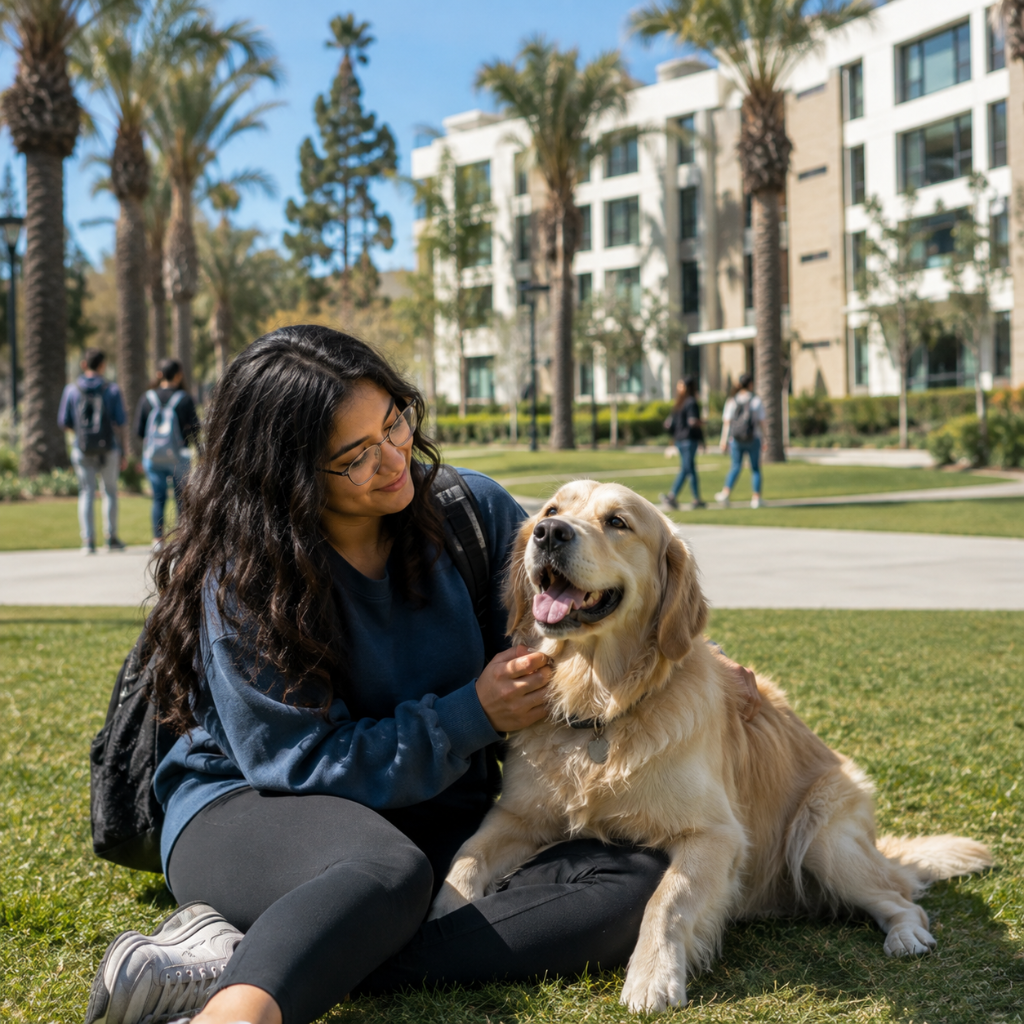
ESA dog in California

Leaving home for the first time can be stressful enough as is, but when living on your own means coping with anxiety, depression, or any number of other conditions, having an Emotional Support Animal (ESA) makes the difference between merely getting by and thriving during your studies. Luckily, students who attend colleges in California have the right to bring their ESAs into campus housing, regardless of whether the college is a “no pets” school, as long as you follow the procedure.

In this article, we will go through how an ESA can help with California campus housing accommodation requests, which department of the college will deal with them, what documentation you’ll need, and what the most common mistakes are.

At California ESA Pet Letter, we assist students in California with getting a properly evaluated, fully-compliant ESA letter by connecting them with certified mental health practitioners. Let us explain how it is done.

Yes, Campus Housing Has to Accommodate Your ESA

The FHA applies to nearly all forms of housing and includes dormitories and on-campus apartments. When a school manages housing, it acts as a housing provider and must accommodate people with disabilities just as any other landlord would have to do. If your dorm has a normal “no pets” policy or a rule that limits residents to keeping only a small fish tank, then this doesn’t supersede the federal disability law.

This is an essential point to understand because the regular policy of the school regarding pets shows what the institution permits based on preferences or property management issues. But the ESA accommodation is required by law; therefore, the two things have completely different regulations, and the school cannot treat these two requests equally.

In California, this legal right is supplemented by another law – the FEHA, and the list of covered housing situations is extended in comparison to federal law only.

Where an ESA Can (and Can't) Go on Campus

This is one of the most common points of confusion for students, so it’s worth being direct about it:

Your ESA is generally allowed:

  • Your dormitory room or campus apartment
  • The hallways and common areas of buildings in which you must travel to take your ESA outside
  • The outdoor relief areas that your campus may have established 

Your ESA is generally not allowed:

  • Classrooms, lecture rooms, or labs
  • Dining halls or campus cafeterias
  • Libraries, gyms, or other shared academic/recreational spaces

The rationale behind this separation is rooted in the separation between ESAs and service animals: the ESA has housing law protection, while the latter falls under public access law. A service dog trained for a person with a psychiatric disability could enter these locations with greater ease under the ADA, but the ESA enjoys its protection specifically in terms of your residence, rather than any location on the college campus. An ESA must be leashed and confined when it is not in your room, and it may be prudent to check out your college’s ESA policy for specifics. 

Featured On

Who Actually Handles the Request

One important thing that often catches many students off guard is the fact that the request isn’t handled through the usual university housing office, like a change in roommates or a maintenance request. The request needs to be directed to the disability office at your college, which is also known as the Office of Accessibility Services, the Office of Student Accessibility, or something along these lines, depending on the institution. Since it is the duty of the disability office to process all accommodation requests under federal disability law, your request will only qualify as a legal accommodation when it is processed via the disability office.

In case you don’t know where exactly it is located at your university, you can easily find it via the student portal of the university under “disability services,” “accessibility resources,” etc.

What Documentation You'll Need

To request an ESA accommodation in campus housing, you’ll typically need:

  • A legitimate ESA letter from an accredited mental health professional
  • An accommodation request form completed in its entirety, usually supplied by the disability services office 
  • Identification of the animal (species, as well as breed and size in some cases)
  • Proof of vaccination, as most universities will insist on this information

California's Documentation Standard: AB 468

Because California has the highest legal requirements of all other states when it comes to ESA letters, the letter you have should meet the guidelines set out in AB 468 (California Health & Safety Code §§ 122317–122319). Regardless of whether it is for your private apartment or for a college dorm room, you need to get your letter from:

  • A licensed mental health care professional with an active license in California
  • A practitioner with whom there has been a true practitioner-patient relationship for 30 or more days
  • A professional who has actually evaluated your condition, rather than completed a questionnaire on the same day

It’s here where many students are taken by surprise. When you plan to receive an ESA accommodation in the fall semester, you can’t just begin the whole process in the week before moving into your apartment. Since, according to AB 468, there has to be a true practitioner-patient relationship for 30 days before the letter is issued, the students will need at least one month, actually closer to two months, considering the time of scheduling and the processing on the campus side. 

Timing: Start Early

Almost all disability service offices suggest that you apply for an ESA accommodation long before the start of the semester. In many cases, they may need up to 60 days’ notice. The fact that the university needs to process your application along with the mandatory 30-day letter from the state of California means that if you apply at the last moment, you will probably have the biggest problem receiving your approval in time. If you plan on having an ESA in your dorm, you should apply as soon as you decide on it.

What Schools Can and Cannot Do

Campus housing generally cannot:

  • Deny your request for an ESA because you have a policy against all pets
  • Charge pet rent, pet deposit, or other fees for your ESA
  • Limit your ESA by breed, size, or weight
  • Require your medical diagnosis or medical records

Campus housing generally can:

  • Ask for an appropriate ESA letter if your condition is not apparent
  • Check whether the letter is issued by a professional
  • Deny the request if your particular animal poses a direct threat due to its behavior
  • Create reasonable policies regarding your building, such as keeping the animal on a leash or carrying it in common areas 

Common Mistakes That Delay or Derail Campus ESA Requests

  • Waiting too long to start. Because of the 30-day minimum required by AB 468, procrastination is the most common reason why requests get delayed.
  • Using an ESA letter issued by a company licensed in another state doesn’t comply with AB 468’s standards. If you went to high school or lived somewhere else before California, chances are your ESA letter will come from an out-of-state licensed company, which makes it non-compliant with AB 468’s standards.
  • Sending the request to the general housing instead of disability services. It might lead to treating your request as a discretionary pet request.
  • Purchasing an online certification. Certificates, registries, or other similar documents have no legal power at all. They don’t comply with AB 468’s standard as well.
  • Lack of mandatory information on the letter. Without the provider’s license number, license type, and letterhead, your request can be put off.

How California ESA Pet Letter Can Help

We make timing our priority when it comes to on-campus ESA requests, and that’s just what we can help students prepare for. California ESA Pet Letter helps students get evaluated by a licensed California mental health provider, helps them build a 30-day relationship before their move-in date, and gets them a fully compliant ESA letter containing all of the information required from disability services office. 

Key Takeaways

The rights to have an ESA on campus in California are federally protected for students at any California college, and such rights are mandatory for colleges to provide because of the Fair Housing Act and FEHA of California. There are several aspects that students should take into consideration when making their request: starting it in advance (30 days according to AB 468), using disability services as the requesting route, and making sure that all information needed is provided.

Frequently Asked Questions

Can my college deny my ESA if the dorm has a strict no-pets policy?

Not really. The Fair Housing Act is stronger than any usual “no pets” policy in relation to a proper ESA. An appropriate ESA accommodation application needs to be treated separately from an optional one.

How far in advance should I request an ESA accommodation for my dorm?

As soon as possible, because most schools require 60 days of notification, while in accordance with California’s AB 468, a 30-day relationship with a provider is required even before a letter can be written.

Can my emotional support animal come with me to class?

No, you are not. Emotional support animals have housing rights but not public access rights, so they can only accompany you to your room and places necessary to leave your room.

Which office handles ESA requests at my California college?

Your school’s disability services or accessibility office handles ESA accommodation requests, not the general housing office. Routing it correctly matters for how the request gets processed.

Can my school charge me a pet deposit for my ESA?

No. Under fair housing law, schools cannot charge pet rent, pet deposits, or apply breed and size restrictions to a properly documented ESA.

Does my ESA letter need to be from a California-licensed provider if I go to school out of state part of the year?

For California campus housing, yes – your letter must come from a provider licensed in California and meet AB 468’s requirements, regardless of where else you may spend time during the year.

Get Your ESA Letter Today — 100% Certified · Adelanto Residents Welcome

Depression, PTSD, OCD, anxiety, and other emotional conditions are already hard enough to manage — your housing situation and travel plans shouldn’t add to the burden. An emotional support animal can make a real difference. Let CaliforniaESAPetLetter.com connect you with a licensed professional who will evaluate your situation and issue a letter that gives your Adelanto life a little more freedom.

Meet Our Licensed Mental Health Professional in California

Dr. Robert Clendenin MD

Dr. Robert Clendenin, MD is a board-certified physiatrist with over 10 years of clinical experience in internal medicine and general surgery. He provides compassionate, patient-focused care through secure telemedicine, offering personalized evaluations and support tailored to each individual’s needs.

License Verification:

You can verify his credentials through the California Department of Consumer Affairs:

https://search.dca.ca.gov/

Medical License No.: C 36830

Session Fee: $149 —

Includes Everything Below

  • Secure video consultation via a telehealth-compliant portal
  • Comprehensive evaluation, diagnosis, and eligibility determination
  • Personalized consultation and treatment recommendations
  • Official ESA (Emotional Support Animal) or Psychiatric Service Animal letter for California
  • Guidance for multiple animals when medically appropriate
  • Assistance completing reasonable accommodation forms for landlords or housing providers
  • Help with airline documentation (additional $60 fee applies)

If, during the evaluation, you are not deemed eligible for an Emotional Support Animal or Psychiatric Service Animal, there is no charge for the visit.

Dr. Clendenin is committed to providing clear guidance, professional documentation, and supportive care to help you navigate housing and travel requirements with confidence.


⚡ Trusted by thousands nationwide. We provide 100% legit ESA & PSD letters — licensed providers, serving all states. Guaranteed approval within 10 minutes.

BOOK AN ONLINE APPOINTMENT NOW