
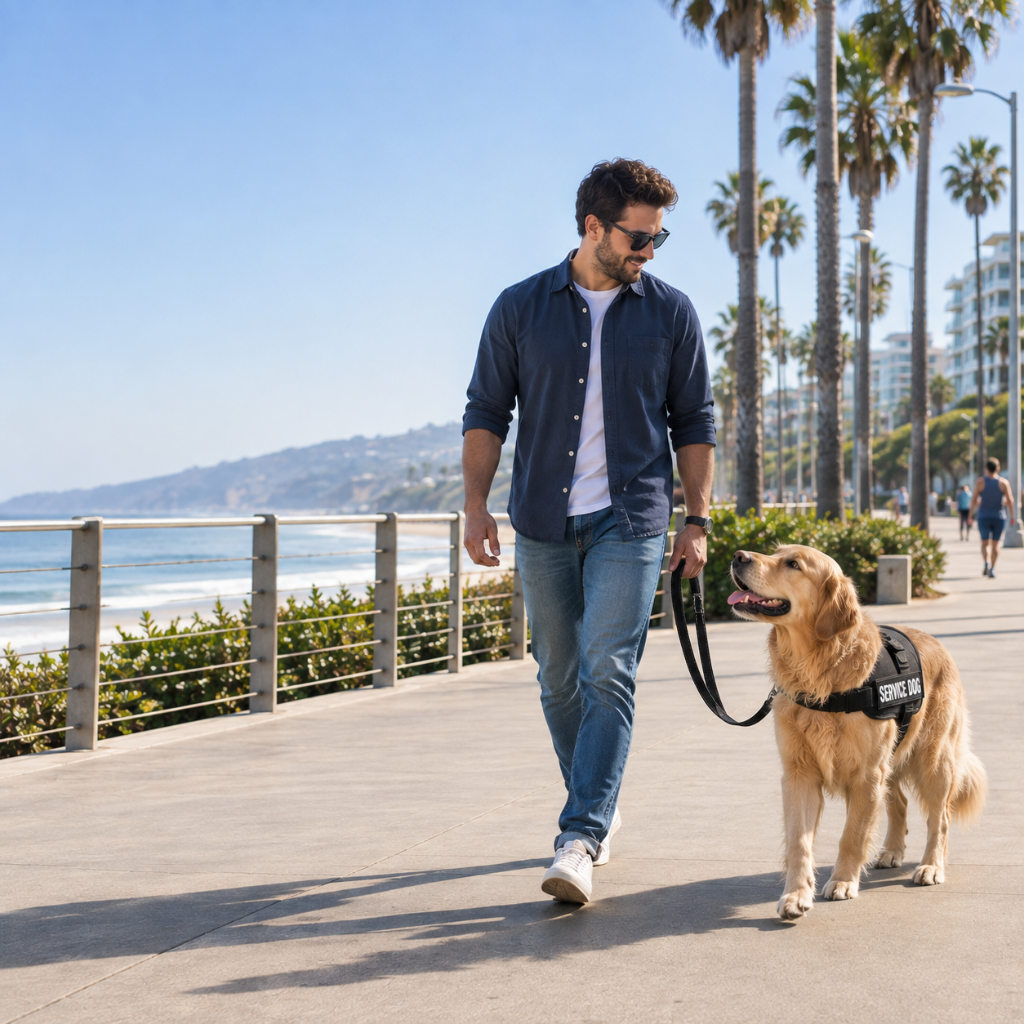




Learn about PSD letters in California, how psychiatric service dogs differ from ESAs, and what documentation may support accommodation requests.
In case you have a psychiatric disability – anxiety, PTSD, depression, panic disorder, or something alike, and your dog provides you with assistance rather than companionship, you need a PSD letter. In case of doubt, check whether the dog performs some trained tasks aimed at alleviating your symptoms and then obtain a PSD letter in California – and do not confuse it with an ESA letter, because the legal status of this document is different from an ESA one.
Below, you can find a step-by-step instruction on what a PSD letter is, how it differs from an ESA letter, which rights it gives you according to California and federal law, and how exactly you can obtain it in 2026.
California ESA Pet Letter assists people who live in California in obtaining a PSD letter after being examined by licensed mental health professionals. If you want to get a PSD letter, continue reading the guide and contact us as soon as possible.
The psychiatric service dog is a canine that has been trained to do certain tasks that will help lessen a handler’s psychiatric disability. The difference between the two lies in this point alone – a PSD is trained to do a task while an ESA merely offers company and affection to its handler because of its mere presence.
Tasks that a PSD is trained to perform can be the following:
Because a PSD is trained to do certain tasks related to a diagnosed disability, it qualifies as a service animal according to the ADA’s definition.
From a legal perspective, neither the Federal nor the California state laws mandate the possession of any paperwork by the handler of a service dog. Generally, businesses are not supposed to ask for disability proof or require paperwork before allowing a service dog entry into their facility. However, life is not always so easy. Landlords, airlines, and some business workers ask for paperwork regardless of the fact.
A PSD letter is a piece of paper issued by a licensed mental health specialist stating that you have a disability, which qualifies your dog to be a service animal performing certain duties related to this disability. This is not a mandatory document; however, it allows:
It’s here that California law gets more detailed, and it’s also the place where many guidebooks miss the mark. According to AB 468 (California Health & Safety Code §§ 122317–122319), the mandatory 30-day client-provider relationship exists for ESA letters – not PSD letters. The purpose of AB 468 is to address the ESA “instant certificate” industry, and the waiting period requirement is associated only with ESA documentation.
Therefore, if a licensed mental health professional conducts a proper evaluation of your disability and needs and evaluates your dog’s trained tasks, then he or she can provide a PSD letter to you immediately, regardless of the mandatory 30-day minimum necessary for ESA documentation. While a reputable company would still conduct a real evaluation because task training and disability-related needs cannot be confirmed in a few minutes of questionnaires, it’s important to note that a rigid 30-day limit is not obligatory for PSDs.
Here’s a side-by-side of what separates the two:
ESA Letter | PSD Letter | |
Animal training required | None | Individually trained to perform tasks |
Public access rights | None | Full ADA public access |
Housing rights | FHA / FEHA | FHA / FEHA (stronger protection) |
Air travel | Treated as a pet | ACAA-protected, cabin access |
AB 468 30-day rule | Applies | Does not apply |
Governing law | State/federal housing law only | ADA, FHA, FEHA, ACAA |
Since a PSD qualifies as a service animal according to ADA guidelines, it will have full public access privileges, including restaurants, retail establishments, hotels, government buildings, and transport. The business can only ask two questions: first, if the animal is needed due to disability, and second, what job it is trained to do. They cannot ask for the details of your disability or demand evidence of it then and there, although having a PSD letter handy can save you some trouble in such situations.
Not only does the federal Fair Housing Act mandate reasonable accommodation for psychiatric service dogs, but so too does the California Fair Employment and Housing Act (FEHA). Landlords cannot charge any pet fees and can impose no breed or weight limits regarding a PSD. However, a landlord can request documentation and verify licensing from your provider if they have no reason to believe you have a disability, and, more importantly, the landlord cannot inquire about your specific diagnosis.
It is also important to mention that HUD’s position on federal enforcement of untrained emotional support animals was changed in its guidance of May 2026 by narrowing the scope to include animals individually trained to perform disability-related tasks. Since a psychiatric service dog is individually trained, by definition, this new guidance does not impact PSD handlers in the same way it impacts ESA handlers – a PSD letter provides one of the strongest forms of housing protection on both the state and federal levels.
Your psychiatric service dog will still be covered by the ACAA even after the recent regulation that reclassifies ESAs into pets. If your dog is trained to carry out tasks, then the airline has to allow it to travel in the cabin without paying any additional cost, provided you fill out the DOT Service Animal Air Transportation form in advance.
The PSD letter confirms a current fact: your dog does certain tasks due to your disability. The training could either be provided by a professional trainer or, in most cases, conducted by you as the handler because there is no necessity to follow any special training programs.
It could be a therapist, psychologist, LCSW, or psychiatrist licensed in California. They will evaluate your condition, its impact on your everyday life, and how it is mitigated by the trained tasks of your dog.
The well-composed PSD letter must have the logo of the provider on it, his license number and type, your qualifying condition, and must explain the duties performed by your dog.
Though it is not required by law to have an expiration date, most property owners and airlines prefer to see the letters that are less than one year old.
California ESA Pet Letter can put you in touch with qualified California clinicians to have a real evaluation made; thus, the PSD letter will represent professional opinion rather than just stamped paper.
A Psychiatric Service Dog letter is granted greater legal rights compared to an ESA letter in California. Specifically, the former implies public access, housing accommodations, and cabin access rights according to the ADA, FHA, FEHA, and ACAA, respectively. What is more important, PSD letters do not have to comply with 30 days limitation of the AB 468 law, yet they have to be issued based on a clinical assessment of your disability and the tasks performed by the dog. Proper issuance of PSD letters from an experienced provider will ensure their efficiency in case any questions are raised.
Curious whether you qualify for PSD? California ESA Pet Letter will help you get in touch with the licensed mental health professionals in California to receive a real PSD letter.
No. The mandatory 30-day client-provider relationship for AB 468 only refers to ESA letters. An authorized provider is able to provide a PSD letter even after a proper clinical evaluation, and there will be no waiting period involved.
Yes. A PSD that is fully trained qualifies as a service animal under the ADA and has full public access rights, unlike an ESA. All business owners may only ask if the animal is necessary due to a disability and what task it performs.
There is no federal or California law requiring documentation for service dogs. However, a PSD letter is highly useful for dealing with landlord demands and disputes regarding the disability being visible.
Yes. Psychiatric service dogs are still covered by the ACAA, and airlines need to accommodate them in the cabin without charge as long as you provide the DOT’s Service Animal Air Transportation Form ahead of time.
No. The Fair Housing Act and California’s FEHA prevent landlords from collecting pet rent and fees on a psychiatric service dog, and landlords cannot enforce any breed or size limitations.
The act of lying about your pet being a service animal is considered a misdemeanor according to California Penal Code § 365.7 with a maximum penalty of six months in prison and/or a $1,000 fine.
Depression, PTSD, OCD, anxiety, and other emotional conditions are already hard enough to manage — your housing situation and travel plans shouldn’t add to the burden. An emotional support animal can make a real difference. Let CaliforniaESAPetLetter.com connect you with a licensed professional who will evaluate your situation and issue a letter that gives your Adelanto life a little more freedom.

Dr. Robert Clendenin, MD is a board-certified physiatrist with over 10 years of clinical experience in internal medicine and general surgery. He provides compassionate, patient-focused care through secure telemedicine, offering personalized evaluations and support tailored to each individual’s needs.
License Verification:
You can verify his credentials through the California Department of Consumer Affairs:
Medical License No.: C 36830
Session Fee: $149 —
Includes Everything Below
If, during the evaluation, you are not deemed eligible for an Emotional Support Animal or Psychiatric Service Animal, there is no charge for the visit.
Dr. Clendenin is committed to providing clear guidance, professional documentation, and supportive care to help you navigate housing and travel requirements with confidence.

Apply online for a California Emotional Support Animal (ESA) letter. FHA-compliant, therapist approved, secure process with fast digital delivery.
©2026 All Rights Reserved.
⚡ Trusted by thousands nationwide. We provide 100% legit ESA & PSD letters — licensed providers, serving all states. Guaranteed approval within 10 minutes.
BOOK AN ONLINE APPOINTMENT NOW